



What is the hardness of rubber?
How is material hardness measured?
This article provides a detailed guide to measuring rubber hardness.
What is the hardness of rubber?
How is material hardness measured?
This article provides a detailed guide to measuring rubber hardness.
What is the hardness of rubber?
Rubber hardness refers to its resistance to indentation by external force, typically measured using Shore Hardness or International Rubber Hardness (IRHD). Higher numbers indicate greater hardness, while lower numbers denote softer material.
For example, 65A rubber may exhibit significant variations in elasticity depending on the formulation.
Hardness Units and Ranges
Shore Hardness: Divided into Type A (soft rubber, 20-95 degrees)—our company's rubber flat belts fall within this range—and Type D (hard rubber, above 90 degrees)
Sealing rings typically use 20-50° (Type A), while industrial rollers can reach 80-95° (Type A) or Type D 50-90°.
IRHD: Applicable for the 10-100 IRHD range, measured by indentation depth using a ball indenter.
How is material hardness measured?
Shore scales can be used as a method of measuring and comparing the hardness of rubbers and elastomers. They are also commonly used for softer plastics such as polyolefins, fluoropolymers, and vinyl. There are around fifteen different shore hardness scales which can be used to measure the hardness of the different materials.
The Shore A scale is most commonly used for measuring the hardness of rubbers and can be determined using a durometer gauge. The durometer consists of a metal truncated cone indenter, attached to a small spring as shown in the diagram above the indenter is extended 2.5mm into the material. The material will resist the indentation, deflecting the spring. Every 0.001 inch that the spring is deflected relates to 1-degree shore A. Harder materials will resist the indentation, this will cause the deflection of the spring to be higher and will result in a higher reading.
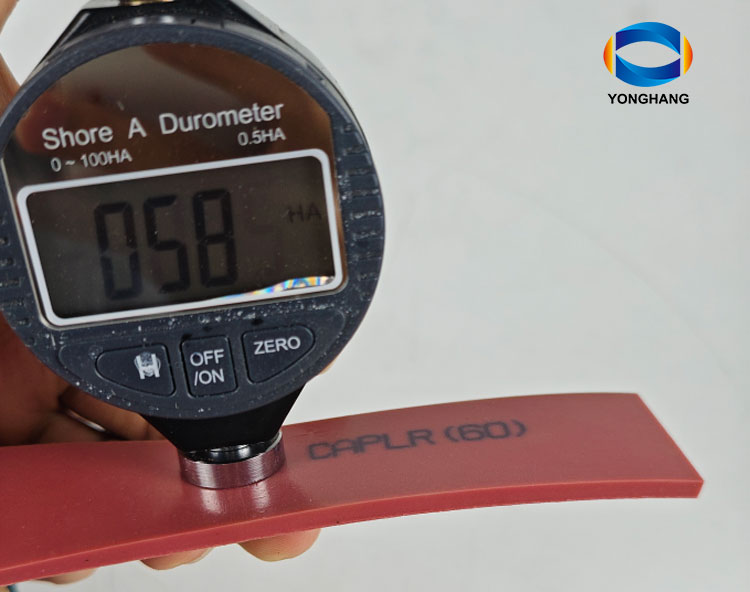
The great thing about the shore hardness scale is that you can measure any material. This scale has been adapted to meet the needs or requirements for any material measurement.
Shore Hardness Testing Explained
Shore hardness testing is widely used for measuring the hardness of rubber and plastics. It involves pressing an indenter into the material and measuring the depth of the indentation. There are two main Shore scales: Shore A for softer materials and Shore D for harder materials.
Shore A: Utilizes a truncated cone indenter with a rounded tip for softer rubbers.
Shore D: Uses a sharp conical indenter for harder rubbers and plastics alue of over 90 degrees.
For example: 30 Shore A is much softer than 80 Shore A. Once a material reaches Shore 95 A, it will resemble a plastic over a flexible material regarding how it feels. In this instance, the Shore A and Shore D scales will briefly overlap. The latter relates to rigid materials whereas the A scale relates to bendable rubbers.
There are other Shore hardness scales, such as Shore OO, O, B, C and H, but they are rare within the plastics and rubber industry. Shore OO is used to test products with a Shore hardness below 10 degrees.Shore C is often used to test foam hardness.
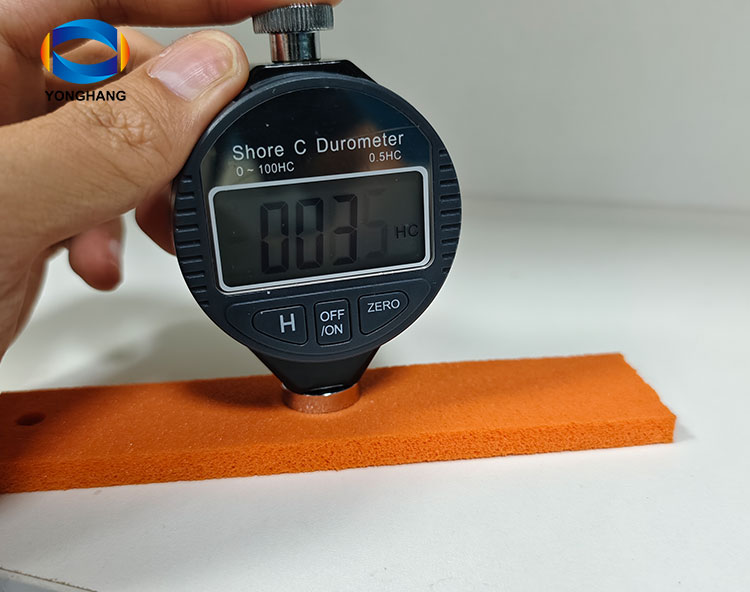
Type ‘C’ ( Shore C). This durometer has a ball-bearing probe that is pressed against the foam, it’s more suitable for measuring foams than the traditional Shore ’A’ hardness gauge, which is used predominantly in the rubber industry. The Shore ‘A’ gauge uses a sprung-loaded pin, which has the tendency to puncture the foam, thereby giving a false reading. The ball-bearing of the Shore ‘C’ gauge spreads the load and allows deflection without puncturing the foam.
The shape of the indenter that is used on the durometer and the spring force vary by scale. For example, shore D uses a sharply pointed indenter and a spring force of 10lbs (4.5 kg) whereas the indenter for shore 00 has a blunt point and a spring force of only 113g.
Shore hardness testing will often leave a permanent indentation in the test sample. Another consideration is that the material must be at least 6mm thick and positioned on a hard surface to get an accurate reading. If the material is too thin, the durometer will measure the hardness of the surface on which the material is placed. Due to the mechanical limits of the test instruments, hardness measurements in elastomers are normally expressed in 5-degree increments
How to measure polyurethane roller hardness (Shore-A scale)
1. Roller surface:
Ensure the surface is clean, smooth, and free from contaminants. Imperfections can lead to inaccurate readings
2. Positioning:
Place the durometer perpendicular to the roller surface, ensuring full contact without tilting.
Start measuring 25 mm (1 inch) from each end of the roller.
3. Apply pressure:
Gently press the durometer down without slamming it. Use about 1 kg (2 pounds) of pressure.
Take the reading immediately upon full contact (within 2 seconds).
4. Temperature:
Measure at room temperature (around 23°C or 74°F). Temperature variations can affect rubber hardness readings.
By following these guidelines, you can reliably measure the hardness of your rubber and polyurethane rollers and optimize performance.
What properties are related to the hardness of rubber?
1. Tensile Strength and Tear Strength
Hardness exhibits a positive correlation with tensile strength and tear strength, but a critical threshold exists. As hardness increases from 50A to 70A, molecular chain crosslinking density rises, enhancing tensile and tear resistance. However, beyond 90A, material brittleness increases, making it prone to fracture due to stress concentration.
2. Compression Set
Low-hardness rubber (below 40A) exhibits superior recovery after compression, making it suitable for sealing applications. High-hardness rubber (above 70A) shows higher compression set rates, leading to seal failure under prolonged pressure.
3. Elasticity
Hardness is inversely related to elasticity:
- Low-hardness rubber (30-50A) offers excellent elasticity, ideal for shock absorbers. High-hardness rubber (60-80A) increases damping but reduces elasticity, suitable for wear-resistant components.
4. Wear Resistance
Increased hardness enhances wear resistance, e.g., extrusion haul off belts reach 65A hardness to withstand abrasion.
However, elasticity must be balanced to prevent fatigue cracks caused by excessive hardness.
5. Weather Resistance and Chemical Resistance
High-hardness rubber, with its dense molecular structure, offers superior resistance to UV radiation, ozone, and chemical media (e.g., oils).
However, rubber hardness decreases at high temperatures (e.g., nitrile rubber loses 20% hardness at 100°C), leading to degraded sealing performance; low temperatures may cause embrittlement.
6. Friction Coefficient
Low-hardness rubber (e.g., 35°C folder gluer paper feed belts) exhibits high surface adhesion and significant friction. High-hardness rubber (e.g., 65A extrusion haul off belts) has a low friction coefficient, making it unsuitable for paper transmission but ideal for traction applications due to its excellent wear re
Summary: The Significance of Measuring Rubber Hardness
Measuring rubber hardness is crucial for quality control and process optimization. As a manufacturer, Yonghang can adjust formulations, as hardness directly correlates with raw material composition (e.g., rubber content, filler type). A 10% decrease in rubber content typically increases hardness by approximately 3-5 degrees. Hardness testing enables optimization of formulation ratios.Mechanical and dynamic performance insights: Hardness changes over time indirectly reflect material aging, providing a basis for predicting service life. Hardness testing is not only a fundamental step in rubber R&D and production but also a core metric for optimizing product performance and ensuring application reliability.

YONGHANG specializes in produce and custom coated transmission belts for 12 years.
Contact Details