Have you ever wondered if it's time to replace a timing belt? For the answer, listen to your engine and follow your machine maintenance schedule
Timing belts themselves are relatively inexpensive but can easily cause thousands of dollars of damage if they break while the machine is running.
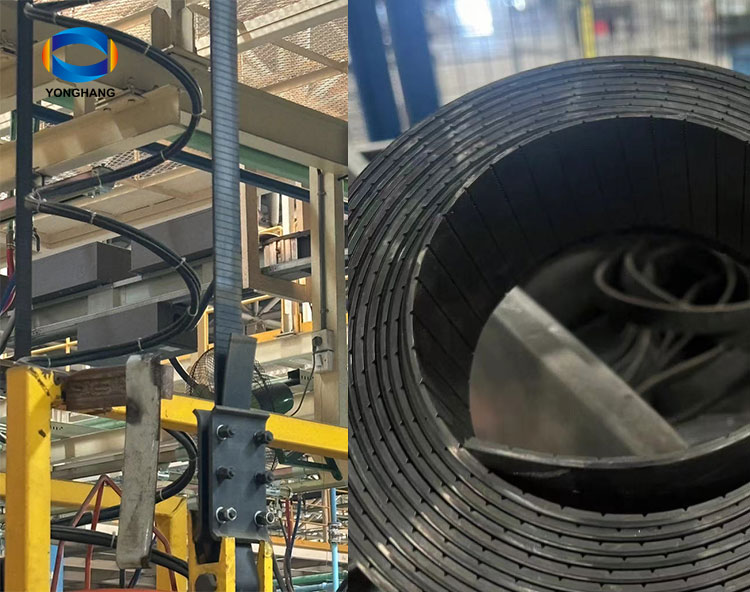
In March this year, our factory received an order for automotive production automation belts from a well-known automotive brand. Their hoist belts utilize P4 steel-cord flat belts, with four belts operating in tandem to lift vehicles. A belt failure caused a week-long production halt, resulting in immeasurable losses. Our expert team investigated and discovered that the P4 steel cord flat belts supplied by another vendor lacked sufficient tensile strength. Testing revealed their breaking load was only half the standard requirement. We urgently replaced them with our Yonghang P4 timing belts, preventing further incalculable damage. However, timing belts are wear-and-tear components. We cannot operate without spare belts, and we must know when these belts should be replaced.
![P4 Polyurethane steel wire flat belt]()
Recognizing the Signs of a Worn-Out Timing Belt
The timing belts on our lift and conveyance systems. We all know these belts aren't the same as the ones inside a car engine. These are the muscles that move parts, lift assemblies, and keep everything flowing smoothly down the line. But just like any hardworking component, they don't last forever. Knowing exactly when to swap them out is the difference between a smooth-running shift and a costly, unplanned downtime.
So, when is the right time to make the change? There's no simple "60,000-mile" sticker for this. It's a judgment call based on a few key factors. Let's break it down.
First, What's the Job and How Hard Are We Working It?
The biggest factor is the application. Is this belt doing light, occasional lifts, or is it constantly moving heavy engine blocks? A belt under high load and continuous operation will have a much shorter lifespan than one in a low-stress, intermittent role. The manufacturer might give a general service-life estimate, but that's just a starting point. Our real-world conditions are what truly matter.
Keep Your Eyes Open: The Tell-Tale Signs
This isn't about waiting for a miracle; it's about proactive inspection. We need to be detectives. Here’s what to put on our checklist:
The Look: Cracks and Fraying are the most obvious red flags. Flex the belt a little. Do you see small cracks on the underside? That rubber is getting brittle. Are the tensile cords starting to show or fray? That's a five-alarm fire. This belt has lost its integrity and is one heavy lift away from snapping.
The Feel: Hardening and Glazing. Grab a belt that's new and feel how pliable it is. Now, feel one that's been running for a year. Has it become hard and stiff? Does the surface look shiny or "glazed"? This is caused by heat and friction, and a hardened belt can't grip properly. It's more likely to slip, which throws off our precious timing and alignment.
The Shape: Stretching and Deformation. Timing belts are designed not to stretch. If we're noticing that our take-up adjustments are maxed out, or if the belt has visibly elongated, it's done. A loose belt will ruin your synchronization, causing misplacement of components and killing our efficiency.
Performance: The Sound and The Sight of Trouble. Are we starting to hear slapping, squealing, or a rhythmic clicking noise? That's the sound of a belt crying for help. It could be misaligned, too tight, or just plain worn out. Also, if we see a buildup of dust around the pulleys, that's the belt literally wearing away before our eyes.
The Smart Approach: Don't Wait for It to Break
The golden rule here is simple: We never, ever run a timing belt to failure. A snapped lift timing belt doesn't just stop one station. It can halt an entire section of the line. The cost of one hour of production downtime dwarfs the cost of a new belt and the 30 minutes it takes to replace it.
Yonghang Expert Group's Recommendation:establish a preventive replacement schedule. Based on our inspections and the belt's duty cycle, we can determine a safe service interval. Maybe it's every 3 months(It is necessary for 6 months)for high-stress applications, or 12 months for lighter ones. By scheduling these changes during planned maintenance windows, we avoid the panic and chaos of a breakdown.
Bottom Line:
Think of these timing belts as critical wear-items, just like a cutting tool. We track their usage, we inspect them regularly, and we replace them before they fail. By staying ahead of the wear, we ensure maximum uptime, protect the precision of our automation, and save the company a ton of money and headaches.
Let's keep those lines moving. Keep an eye on those belts, and when in doubt, swap it out
Why choose Yonghang timing belt as your supplier?
We go beyond being just a vendor. As a dedicated manufacturer, not a distributor, we offer direct control over quality and cost. Our strength lies in providing technical support, reliable and durable products, and flexible custom solutions tailored to your project. We partner with you to ensure your drives perform flawlessly, enhancing your product's reliability.
What specifications do I need to provide to select the correct Timing Belt?
A: To ensure a perfect match, we recommend providing the Pitch (e.g., MXL, T5, AT5, HTD 5M, 8M), Belt Width, and Length/Circumference. Additionally, sharing your application details—such as load torque, operational speeds, and environmental conditions (temperature, exposure to chemicals)—allows us to recommend the optimal belt for your system's performance and durability.
Can you produce custom-designed Timing Belts for our specific application?
A: Yes, custom manufacturing is our specialty. We offer various types of belt materials for your timing belt selection.We can produce non-standard widths, lengths, and closed-loop endless belts. We also engineer belts with special tooth profiles (e.g., TK ATK BATK ATP ATN) and different tensile cord materials like carbon steel core wire or Kevlar to meet unique load, flexibility, and precision requirements for OEM and specialized machinery.
How do you ensure the precision and quality of your Timing Belts?
A: Precision is built into our process. We utilize advanced molding technology and strict quality control at every stage. This ensures exact tooth profile accuracy, consistent pitch, and perfect synchronization, which are critical for applications requiring high positional accuracy, such as in robotics, CNC systems, and precision conveyors.
What are the differences between fiberglass and aramid (Kevlar) tension cords in timing belts?
A: The choice of tensile cord is critical for performance. Fiberglass cords offer high tensile strength with very low stretch, ideal for most general applications. Aramid (Kevlar) cords provide exceptional strength with greater flexibility and superior resistance to repeated flexing and shock loads, making them perfect for high-performance, high-speed drives.
In which industries are your Timing Belts commonly used?
We mainly produce two types of synchronous belts: rubber synchronous belts and PU synchronous belts. The rubber synchronous belts are more friendly to some household appliances, 3D printers, etc., while the PU synchronous belts are more widely used. Compared to the rubber synchronous belts, the PU ones are more resistant to chemical substances and common solvents. They are applied in fields such as Automation & Robotics, Medical Devices, and CNC Machinery. We provide reliable, clean, and efficient power transmission, which these high-tech industries rely on.
What are the best practices for installing and maintaining a Timing Belt system?
A: For maximum lifespan, follow these key steps:
· Correct Tensioning: Avoid over-tightening, which causes bearing wear, and under-tightening, which leads to slippage and ratcheting.
· Proper Pulley Alignment: Misaligned pulleys are a primary cause of premature belt wear and failure.
· Use Matched Pulleys: Always use pulleys with the correct tooth profile and pitch for the belt.
· Keep Clean: Protect the drive from excessive dust and debris.
What is your Minimum Order Quantity (MOQ) for custom or OEM orders?
A: We offer flexible and competitive MOQs to support businesses of all sizes, from startups needing prototype quantities to large-scale OEMs. We are committed to being a accessible partner, so please contact us to discuss your specific volume needs.
Hi,I am AKI author of this post. We have over 8 years of industrial belt production, and we already offered more than 50 countries foreign customers with top quality PU timing belts and transmission belts, such as PU timing belts coating belt for ceramic industry , PU timing belt for food industry, flat power transmission belt for printing industry and etc. If you have any requests, get in touch with us for free quote and give you professional suggestion.
![yonghang belts aki]()