



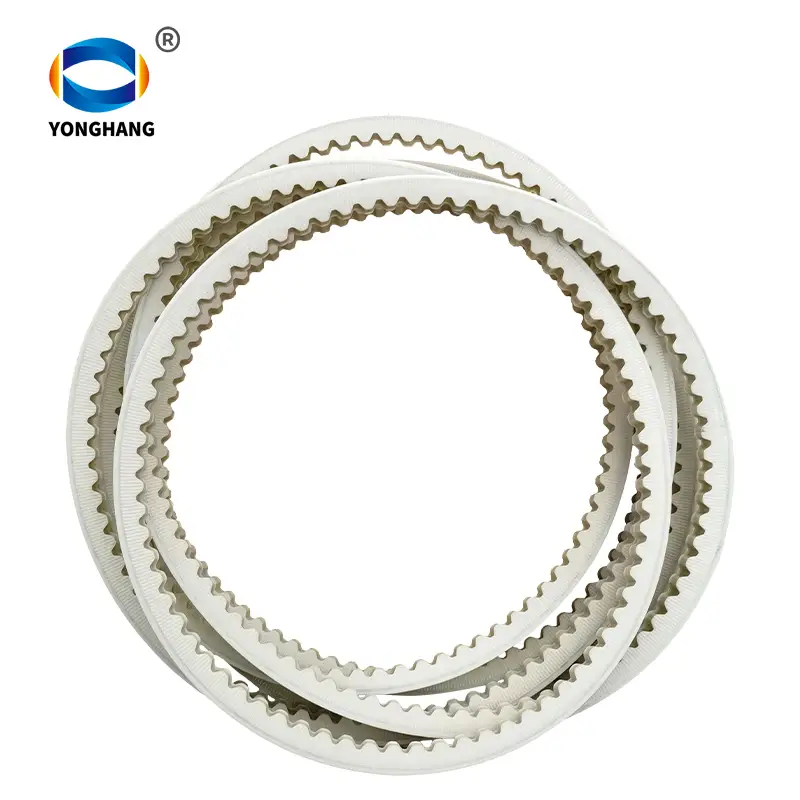
Food Grade Polyurethane (PU) V Belt
Food Grade Polyurethane (PU) V Belt is mainly manufactured using polyurethane materials that meet food safety standards.The material formula is usually certified by authoritative institutions such as the FDA (Food and Drug Administration of the United States), EU 10/2011 (European Union Food Contact Materials Regulation), or NSF/USDA, to ensure that it will not cause contamination when in accidental contact with food.Food-grade polyurethane V-belts are the most ideal alternative to black rubber V-belts in modern food industry.
Type:V belt
Colour:White
Material:Polyurethane (PU)
Application:Food & Beverage &glove &pharmaceutical factory
What are Polyurethane (PU)V-Belts?
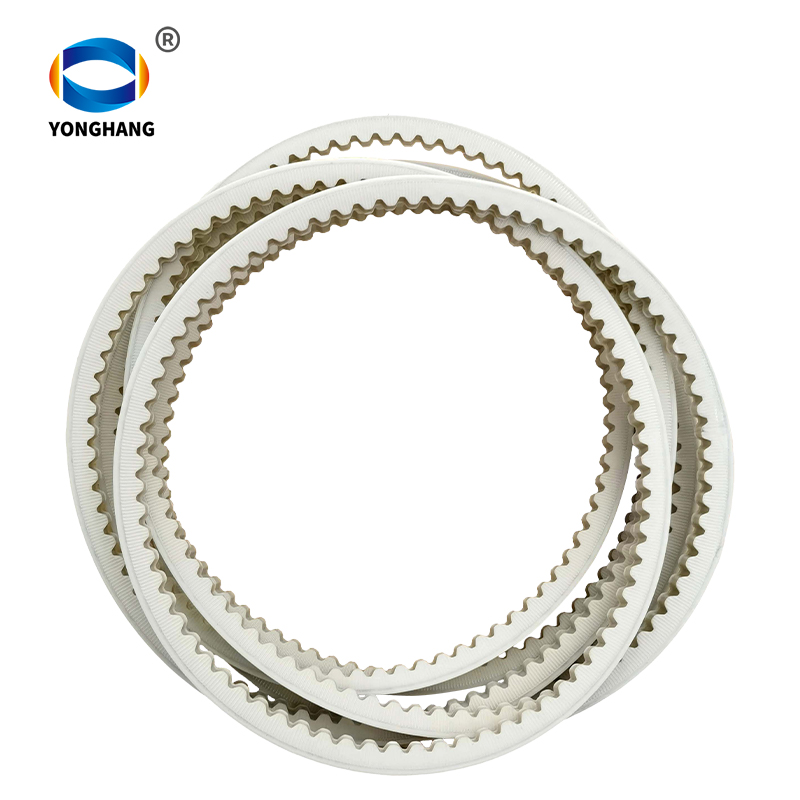
Polyurethane (PU) V-Belts are power transmission belts with a trapezoidal (V-shaped) cross-section, made primarily from a polyurethane elastomer. They are a modern alternative to traditional rubber V-belts and are known for their high performance, durability, and cleanliness.
The "V" shape works on the same principle as traditional belts, wedging into the pulley groove to create high friction and transmit power efficiently.
Key Advantages of Polyurethane (PU)V-Belts
Polyurethane as a material offers several distinct benefits over standard rubber:
Superior Abrasion Resistance: PU is extremely resistant to wear and tear, leading to a much longer service life, especially in dusty or abrasive environments.
High Tensile Strength: They can transmit higher loads in a more compact size compared to classical belts. They are often reinforced with high-tensile polyester or aramid(Kevlar) cords.
Excellent Resistance to Oils and Grease: Polyurethane is highly resistant to degradation from oils, lubricants, and many chemicals, making it ideal for machinery in industrial settings.
Resistance to Ozone and Oxidation: Unlike rubber, PU does not crack or harden when exposed to ozone, a common cause of premature failure in rubber belts.
Low Stretch (Excellent Creep Resistance): The reinforcement cords are often bonded directly into the PU, resulting in minimal permanent stretch. This maintains drive tension for longer periods and reduces the need for re-tensioning.
Clean Operation: They do not contain carbon black, so they are naturally non-marking. This makes them suitable for:
Food Grade Applications: Specific PU compounds can be formulated to meet FDA and USDA standards for incidental food contact. These are often white or light-colored.
Packaging, Printing, and Textile Industries: Where black marks from rubber belts would ruin products.
Common Types and Profiles
Polyurethane V-Belts come in the same standard profiles as traditional belts, allowing them to be direct replacements on existing pulleys.
Classical V-Belts (Less Common in PU): While available, the full A, B, C, D series is less common in PU, as its strengths are better utilized in more modern profiles.
Narrow Wedge Belts (e.g., 3V, 5V, 8V): These are very common. They transmit more power in a smaller space than classical belts. You'll often see them labeled as:
PH (PJ, PK): A metric series of poly v belts.
FHP (Fractional Horsepower) Belts: Used on small drives under 1 HP, like fans, appliances, and outdoor power equipment. The 2L, 3L, 4L, 5L series is common here.
Double-Sided (Hex) Belts: These have a V-profile on both sides and are used in serpentine drives where the back of the belt contacts an idler pulley.These are very common.
Typical Applications
Polyurethane (PU)V-Belts are chosen for demanding applications where reliability and cleanliness are critical.
Food & Beverage Processing: On mixers, conveyors, and packaging equipment (using food-grade versions).
Logging and Sawmill Equipment: On bandmills, edgers, and other high-shock load machinery.
Industrial Machinery: Pumps, compressors, and machine tools where oil resistance is needed.
Vintage and Classic Vehicles: Often used as a durable, long-lasting, and clean alternative to original rubber belts.
Textile Industry:In the textile industry, the wear of black rubber V-belts can leave marks and contaminate white textiles. Therefore, polyurethane (PU) V-belts are the alternative products.
Comparison: Polyurethane vs. Traditional Rubber V-Belts
Important Selection Considerations
Static Electricity: A critical point. Standard black rubber belts are often static conductive. Most PU belts are NOT. If your machine requires a static-dissipating belt (e.g., in explosive atmospheres or to protect electronics), you must specifically seek out a conductive PU belt.
Replace in Matched Sets: On multi-belt drives, always replace all belts at the same time to ensure even load distribution.
Pulley Condition: Always check that the pulley grooves are clean, smooth, and within wear limits. A worn pulley will destroy any new belt quickly.
In summary, a Polyurethane V-Belt is a high-performance, durable, and clean option ideal for demanding applications involving oil, abrasion, and where non-marking operation is essential. While they have a higher upfront cost, their extended service life often makes them more cost-effective in the long run.
YONGHANG specializes in produce and custom coated transmission belts for 12 years.
Contact Details