



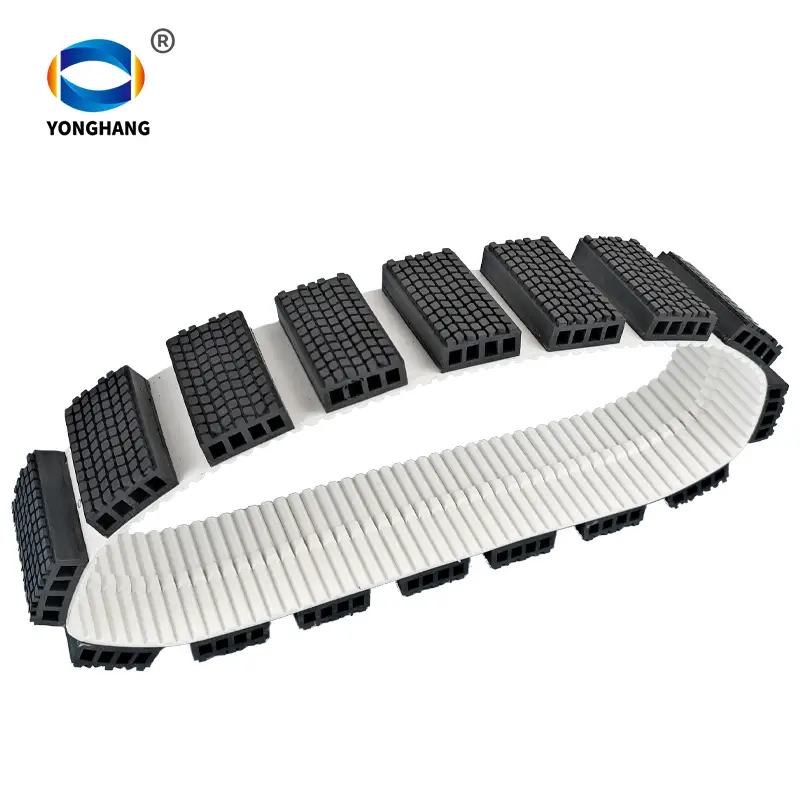
Ultra-Grip Crawler Track Belts for High-Incline PV Cleaning Robots
Product Overview
Navigating steep-pitch solar arrays requires a specialized traction interface that balances extreme grip with delicate surface handling. Our Crawler Track Belts are specifically engineered for Photovoltaic (PV) Cleaning Robots tasked with scaling high-incline installations.
By integrating a high-modulus Polyurethane (PU) drive core with an ultra-soft 30 Shore A synthetic rubber coating, we have created a "high-adhesion" track system. This hybrid construction allows robotic units to maintain a steady, non-slip ascent on glass surfaces even under challenging environmental conditions, ensuring consistent cleaning coverage without the risk of downhill drifting.
Technical Specifications
| Engineering Property | Value / Detail |
| Substrate Material | High-Tensile Thermoplastic PU |
| Traction Surface | Specialized 30 Shore A Synthetic Rubber |
| Durometer (Hardness) | 30 Shore A (Ultra-Soft / High-Friction) |
| Maximum Operating Slope | Up to 27 Degrees |
| Reinforcement Core | Continuous Helical Steel or Aramid Cords |
| Environmental Shielding | UV-Stabilized & Hydrolysis-Resistant |
Advanced Performance Features
Vertical Stability & 27° Incline Mastery
Most standard tracks fail when the slope exceeds 20 degrees. Our engineering team has optimized the 30 Shore A rubber formulation to provide a "suction-like" grip. This high coefficient of friction is specifically rated for 27-degree operating slopes, allowing cleaning robots to operate safely on the steepest commercial and utility-scale rooftop arrays.
Surface Integrity & Anti-Reflective Protection
The ultra-soft 30 Shore A profile is designed to be gentler than the glass it cleans. It provides maximum surface contact to distribute the robot's weight evenly, preventing micro-scratches or degradation of the solar panel's anti-reflective coating (ARC).
Synchronous Drive Precision
While the outer coating provides the grip, the PU base belt ensures the timing. The internal steel reinforcement prevents belt elongation (stretching). This ensures that the robot’s sensors and motors remain perfectly synchronized, which is critical for autonomous pathfinding and avoiding "crabbing" or misalignment on the panel rows.
Wet & Dry Versatility
Whether your maintenance protocol involves dry brush desanding or high-pressure wet washing, these tracks maintain their physical properties. The synthetic rubber is engineered to break surface tension in wet conditions, preventing the hydroplaning effect that often leads to robotic failure on inclined glass.
Ideal Applications
-
Steep-Pitch Commercial Rooftops: Reliable cleaning for solar arrays with aggressive tilt angles.
-
Autonomous Vertical Cleaners: Essential for robots that require "suction-level" grip for safe ascent.
-
Utility-Scale "Waterless" Robots: Maintaining traction in sandy, arid desert environments where dust acts as a lubricant.
💡 Expert Installation Advice
For robotic systems operating at the 27-degree limit, we recommend specifying a Kevlar (Aramid) reinforcement if your robot is weight-sensitive. For heavy-duty industrial robots, a Steel cord core is preferred to handle the high shear forces exerted on the 30 Shore A coating during steep-angle starts and stops.
YONGHANG specializes in produce and custom coated transmission belts for 12 years.
Contact Details