



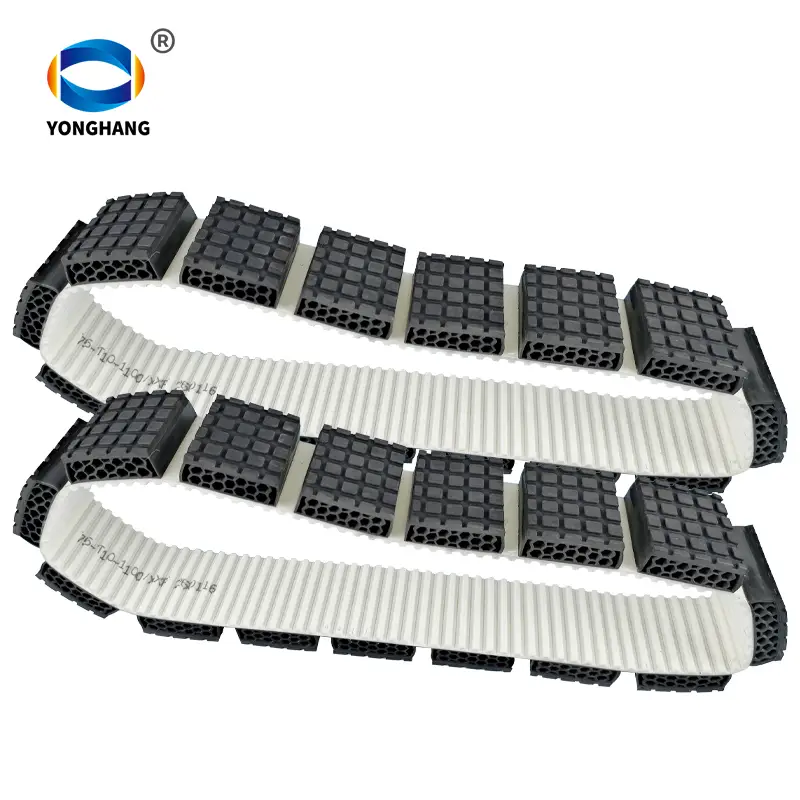
High-Traction Crawler Track Belts for Photovoltaic Cleaning Robots
Product Overview
Navigating the variable topography of utility-scale solar installations requires more than just standard propulsion. Our Crawler Track Belts are engineered to bridge the gap between industrial power transmission and delicate surface interaction. By fusing a high-modulus Polyurethane (PU) core with a precision-applied synthetic rubber coating, we provide a robust solution for automated PV maintenance.
This series features a 62-65 Shore A durometer rating, intentionally selected to provide a "firm-grip" interface. It offers the stability required for moderate inclines while minimizing the energy loss associated with overly soft, high-friction materials. These tracks ensure your robotic cleaners maintain steady velocity and precise pathing, regardless of the solar farm's surface conditions.
Technical Specifications
| Property | Value |
| Drive Core | High-Tensile Polyurethane (PU) with Steel Cord |
| Coating Type | Bonded Synthetic Rubber |
| Durometer Hardness | 62–65 Shore A |
| Operational Slope | 16° – 19° |
| Profile Compatibility | T10 / AT10 / 8M (Customizable) |
| Material Resistance | UV-Stabilized, Ozone-Resistant, Oil-Tolerant |
Unique Engineering Advantages
Balanced Friction Dynamics
While ultra-soft tracks are prone to rapid degradation, our 62-65 Shore A coating offers a sophisticated balance. It provides sufficient mechanical adhesion to tackle 16-19 degree slopes without slipping, yet retains enough rigidity to prevent "bunching" or deformation under the weight of heavy cleaning equipment.
Zero-Stretch Synchronization
The core of our crawler track is a reinforced PU timing belt. Unlike standard rubber belts that may stretch over time and cause tracking misalignment, our PU base ensures that the left and right tracks remain perfectly synchronized throughout the robot's service life. This minimizes steering motor strain and maximizes the lifespan of your robotic drive system.
Efficient Power Transfer
The specific hardness of this rubber formulation reduces rolling resistance. By preventing the "cushioning effect" found in softer tracks, the robot requires less torque to initiate movement. This efficiency translates to longer operational runtimes between battery charges, increasing the overall cleaning capacity of your robotic fleet.
Field-Proven Longevity
Solar farms are challenging environments defined by high UV exposure and temperature fluctuations. Our synthetic rubber coating is formulated to resist photochemical degradation. The material remains stable—neither becoming overly brittle in the cold nor excessively tacky in extreme heat—ensuring consistent performance throughout the year.
Applications
-
Utility-Scale Solar Cleaning: Designed for long-run operations on vast, inclined arrays.
-
Autonomous Cleaning Fleet: Ideal for high-end robots requiring precise, repeatable pathing.
-
Retrofit Compatibility: Fits most standard timing belt-driven crawler chassis used in modern cleaning systems.
💡 Engineering Recommendation
When designing your robot's drive system for a 16-19 degree slope, ensure that your idler wheel tension is calibrated for a high-modulus belt. Because these tracks utilize a 62-65 Shore A surface, they have a higher resistance to deformation; therefore, maintaining proper tension is vital to leverage the track's full grip potential without causing unnecessary lateral stress on the drive shaft.
YONGHANG specializes in produce and custom coated transmission belts for 12 years.
Contact Details